
Perched on a bend of the Nile between Luxor and Aswan, Kom Ombo Temple solves an unusual architectural problem: how do you build a single temple dedicated equally to two different gods, without either one appearing to outrank the other? The answer is one of ancient Egypt’s most distinctive feats of religious engineering — a temple built almost entirely in mirrored symmetry.
A Temple Split Perfectly in Two
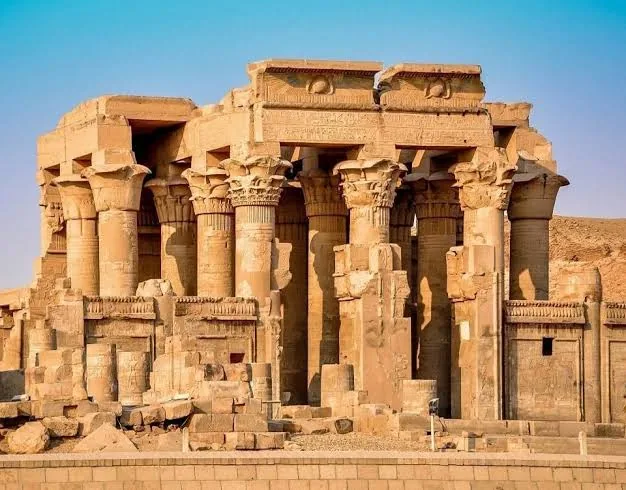
Kom Ombo is a double temple: one half dedicated to Sobek, the crocodile god associated with fertility and the Nile’s power, the other to Horus the Elder, falcon god of kingship and the sky. Rather than merging the two cults into a single layout, the builders mirrored the entire structure along a central axis — two entrances, two courts, two hypostyle halls, two sanctuaries, running in perfect parallel from front to back.
Why Symmetry Was the Real Engineering Challenge
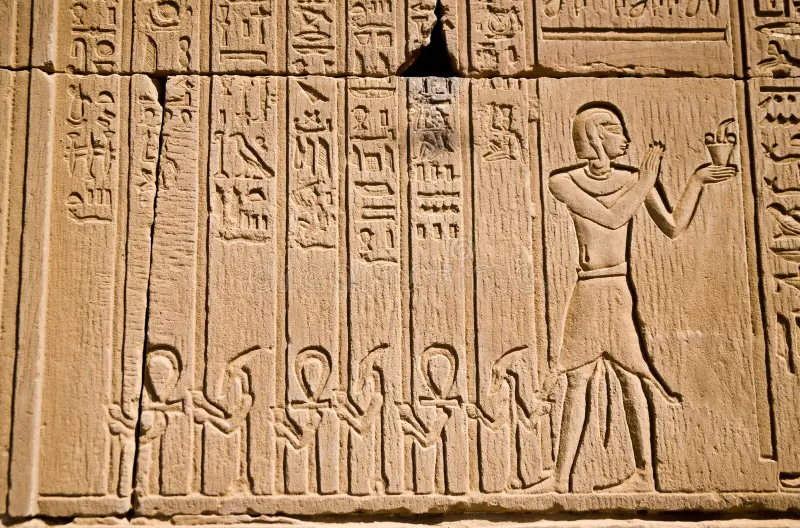
Building in true mirror symmetry is harder than it looks. Every architectural element — column spacing, wall thickness, ceiling height, even the placement of individual reliefs — had to be duplicated precisely on both sides, without the structure favoring one half over the other in scale or prominence. The result reads, even today, as a masterclass in balanced design: stand at the temple’s central axis and the two halves feel genuinely equal, neither god’s side larger or more elaborate than the other’s.
Built in Layers, Over Centuries
Most of what stands today was built during the Ptolemaic period (roughly 180–47 BCE), with later additions under Roman rule — meaning the temple’s symmetrical design had to be maintained consistently across multiple building phases and generations of architects, a notable feat of long-term planning and continuity.
Surviving the Nile’s Power
Kom Ombo sits unusually close to the Nile’s edge, and over the centuries the river has eroded and damaged portions of the temple, including the complete loss of its outer pylon. What remains demonstrates how ancient builders accounted for a riverside location — foundation techniques and stone selection suited to a site more exposed to flooding and erosion than most inland temples.
What to Look For When You Visit
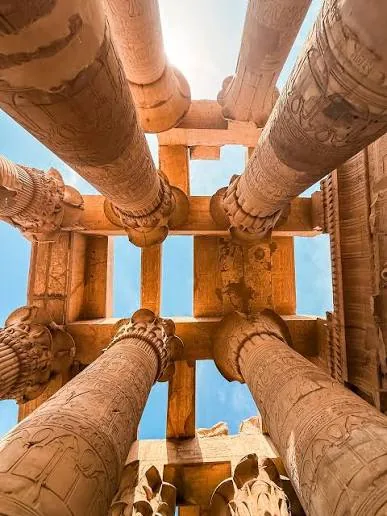
- The dual sanctuaries at the rear of the temple, still clearly showing the mirrored layout.
- A relief said to depict surgical instruments — often cited as evidence of ancient Egyptian medical knowledge, carved on one of the rear walls.
- The adjacent Crocodile Museum, displaying mummified crocodiles once sacred to Sobek, found at the site.
- The nilometer, a graduated well used to measure the Nile’s flood levels, still visible near the riverbank.
Visiting Kom Ombo
Most travelers see Kom Ombo as a stop between Luxor and Aswan, either by road or as part of a Nile cruise itinerary — its riverside setting makes it one of the more photogenic temple visits in Upper Egypt, particularly in the golden light of late afternoon.
If you would like to experience everything described in this article in real life, we offer carefully designed private and small-group Egypt tours that cover this place. Our Egyptologist-led itineraries can be tailored around exactly what interests you most.